


By Eleanor Kent, Army FUZE
TRUPPENÜBUNGPLATZ PUTLOS, GERMANY — Small unmanned aerial systems remain one of the fastest-evolving threats on today’s battlefields, challenging U.S. and allied forces across every domain. Adversaries are increasingly leveraging low-cost, rapidly deployable aerial platforms to disrupt operations, erode freedom of maneuver, and increase risk to personnel and critical infrastructure – shifting counter unmanned aircraft system (C-UAS) solutions from a niche concern to a defining operational priority.
In response, the U.S. Army is accelerating its search for deployable C-UAS technologies it can field rapidly, integrate effectively, and scale across the force. This fall’s xTechCounter Strike competition and subsequent live experimentation event – executed in partnership with the Global Tactical Edge Acquisition Directorate (G-TEAD), U.S. Army Europe and Africa (USAREUR-AF), and the 52nd Air Defense Artillery Brigade – demonstrated how rapid discovery and operationally grounded experimentation can come together to advance those solutions.
A Competition Built for Operational Relevance
xTechCounter Strike was designed around a simple premise: capabilities intended for contested environments must be evaluated in conditions that reflect them. xTech selected finalists for technical maturity and potential to address C-UAS demands, including technology readiness levels (TRL) of 6 or higher, and the ability to support rapid deployment timelines aligned with the North Atlantic Treaty Organization’s (NATO) ongoing Eastern Flank Deterrence Line initiative which focuses on enhancing ground-based capabilities and interoperability across the alliance. The competition culminated in a live experimentation event with Project Flytrap 4.5 led by Army V Corps at Truppenübungsplatz Putlos. There, Army and Department of War (DoW) experts assessed systems in representative field settings, observing how quickly and effectively Soldiers could train, integrate, and employ them against realistic threat scenarios.
The event provided a mission-relevant environment that enabled participating companies to work directly with Soldiers, align technology with unit workflows, and demonstrate performance in conditions that mirrored those faced by forward-deployed units. As part of that integration, ten firms worked with Soldiers from the 52nd Air Defense Artillery Brigade to integrate their systems into Project Flytrap 4.5 platform – a modular, expeditionary testbed – before training units to operate the technologies independently under compressed timelines. These interactions offered critical insights into usability, survivability, and integration needs – insights that emerge only when Soldiers use systems under real field conditions.
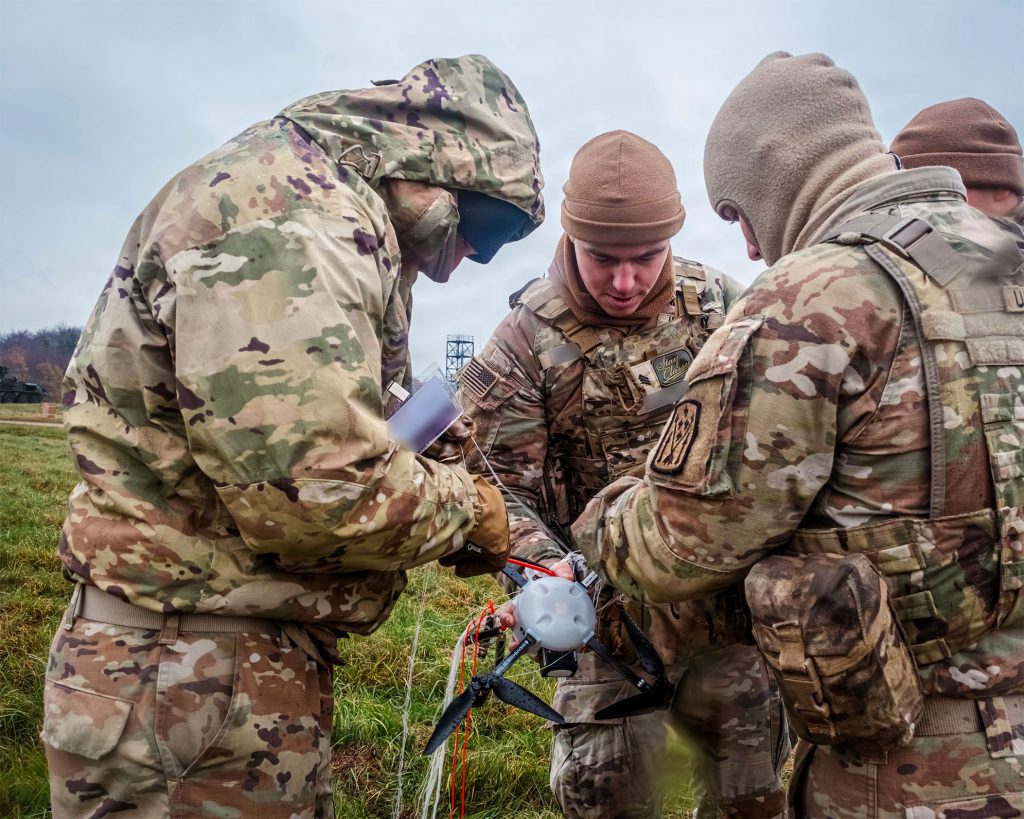
Soldiers inspect captured drone during Project Flytrap 4.5 at Truppenübungplatz Putlos, Germany
Partnerships Driving Synchronization and Speed
The experimentation event also marked the first Army FUZE xTech Program collaboration with the G-TEAD. This partnership reflects the Army’s broader shift toward greater coordination across its innovation ecosystem. As part of the newly established Pathway for Innovation and Technology (PIT), Army FUZE and G-TEAD are working in more integrated ways to accelerate promising technologies.
G-TEAD’s involvement in xTechCounter Strike demonstrated this approach in action, highlighting the growing emphasis on aligning acquisition pathways with operational demand signals, compressing the timeline between early discovery and actionable evaluation. By bringing acquisition authorities, operational formations, and technical evaluators into a shared assessment environment, the Project Flytrap 4.5 experimentation showcased a more synchronized approach to identifying and advancing capabilities that address urgent C-UAS challenges.
“We quickly realized one of the easiest ways to accelerate capability is to partner with existing companies and existing organizations.” said Maj. Joshua McMillion, G-TEAD’s capability lead.
His perspective underscores the value of the xTech model, which creates the early touchpoints that allow Soldiers, acquisition teams, and commercial innovators to work together in one environment. This integration is especially important for rapidly evolving mission areas like C-UAS.
The multinational nature of the event highlighted a second, critical dimension: C-UAS threats are global, and the solutions to address them must be interoperable, adaptable, and effective across coalition forces. NATO and allied leaders who visited during Distinguished Visitors (DV) Day gained early visibility into how emerging systems could strengthen multinational defense posture, demonstrating that the technologies advanced through xTechCounter Strike carry implications beyond a single formation or theater.
Announcing the Winners
Following the live assessments, the Army identified four companies whose technologies demonstrated strong potential for continued development and operational relevance. MatrixSpace, Armaments Research Company, Mountain Horse Solutions, and AG3 Labs were selected as the final winners and will receive monetary awards up to $350,000, in addition to the opportunity for further consideration with the G-TEAD Marketplace, supporting ongoing maturation and potential transition.
More about the xTechCounter Strike winners: https://xtech.army.mil/competition/xtechcounterstrike/.
A Repeatable Model for Soldier-Led Assessment
xTechCounter Strike demonstrated that early, field-based Soldier interaction is what makes the difference. That direct feedback shortens decision timelines, clarifies operational viability, and signals which technologies merit continued investment by moving mature capabilities into realistic conditions far sooner than traditional approaches allow. The Truppenübungsplatz Putlos event reinforced a repeatable pathway for rapidly advancing promising C-UAS capabilities, positioning winners for potential follow-on opportunities through mechanisms such as the G-TEAD Marketplace.
As the Army advances modernization and acquisition reform, aimed at faster, more adaptive capability development, competitions like xTechCounter Strike demonstrate what becomes possible when operators, innovators, and acquisition teams are connected early and often. The result is a more informed, more agile, and more mission-aligned pathway for identifying the technologies that can make a measurable difference for Soldiers on the ground.
About the Army FUZE xTech Program
The Army FUZE xTech Program is the Army’s premier tool for scouting and accelerating dual-use technologies that directly enhance Soldier readiness and mission success. Through dynamic prize competitions like xTechSearch, xTech identifies breakthrough solutions and opens doors for nontraditional companies to engage with and deliver capabilities to the Army. Since its launch in 2018, xTech has awarded over $30 million in non-dilutive cash prizes across 48 competitions – fueling innovation pipelines and delivering transformative technologies that matter on the battlefield.
Learn more at the Army FUZE xTech website: https://fuze.army.mil/.
About Army FUZE
Army FUZE is the Army’s integrated innovation ecosystem. It brings together four flagship innovation programs – xTech, Small Business Innovation Research and Technology Transfer, Manufacturing Technology, and the Technology Maturation Initiative – under a coordinated and synchronized framework to accelerate advanced capabilities, strengthen the industrial base, and deliver readiness at the speed of relevance. FUZE operates with a venture capitalist mindset, scouting broadly, taking calculated risks, and scaling the most promising technologies. This approach ensures taxpayer dollars are directed toward solutions with both Army operational relevance and commercial viability, while creating clearer pathways and reduced barriers for industry participation.
Stay Updated
Subscribe to email updates or check back on the Army xTech website. Follow us on Facebook, LinkedIn, YouTube, and Flickr. For inquiries, contact us at the Army xTech mailbox.