


By Sarah Hepburn, Office of Army Innovation Programs
WASHINGTON—Compound Eye, a small business based out of Redwood City, Calif., is leveraging $13 million in Army SBIR CATALYST funding to develop a cutting-edge positioning and navigation tool for U.S. Army Soldiers based off its Visual Inertial Distributed Aperture System (VIDAS). Although the company is now well on its way to advancing its VIDAS technology for the Army – a passive 3D-mapping alternative to active sensors such as LiDAR – Compound Eye was initially hesitant to engage with the Department of Defense.
After discovering a viable pathway through the Army xTech Program and receiving subsequent funding via the Army Small Business Innovation Research Program, Compound Eye emerged as a strategic partner in solving Army challenges related to navigation and situational awareness in GPS-denied and degraded environments.
In early 2020, Compound Eye submitted a proposal to xTechSearch 5, the Army’s flagship open-topic prize competition, for their VIDAS technology. The passive, artificial intelligence-powered architecture integrates low-cost cameras and inertial measurement units to deliver high-fidelity 3D perception without detectable signals, supporting autonomous platforms that thrive in contested, GPS-denied terrain.
VIDAS demonstrated clear alignment with the Army’s operational priorities, delivering a stealthy, passive, and resilient sensing capability tailored for contested environments. The solution earned Compound Eye recognition as a finalist in xTechSearch 5, along with $145,000 in cash prizes, and became modularly adapted in future Army contracts to address emerging operational requirements, ultimately serving as the foundation for advanced systems such as VIDAS-SLAM.
Prior to xTechSearch 5, Compound Eye had never worked with the DOD. The company credits xTech’s “friendly front door” for lowering the barrier to entry and enabling nontraditional innovators like themselves to engage with the DOD.
“Having spent several years now studying the defense market, I believe the xTech Program is the best front door the DOD has created thus far. This is partially because, by advancing to the finals of the xTechSearch 5 competition, we also received the opportunity to participate in the xTech Accelerator Program,” said Jason Devitt, co-founder and CEO of Compound Eye. “The xTech Accelerator provided invaluable insight into how the DOD operates, while connecting us directly with potential end-users and strategic partners, including prime contractors.”
Among the many benefits that the xTech Program offered Compound Eye, one of the most impactful was that it led to the opportunity to submit a Direct to Phase II Small Business Innovation Research proposal for VIDAS. In 2021, the company received its first Direct to Phase II Army SBIR contract of $1.56 million to modify VIDAS technology to the requirements of Army combat vehicles, enhancing their ability to operate effectively in degraded visual and contested environments. This marked the beginning of the company’s relationship with Program Executive Office Ground Combat Systems.
Just one year later, Compound Eye secured a $1.7 million Direct to Phase II SBIR award, again with PEO GCS as its partner, to enhance perception sensing for autonomous ground systems. Building on the foundation of its VIDAS technology, the award focused on significantly extending the range and precision of perception sensing in complex operational environments, bringing next-generation situational awareness closer to deployment.
“The xTech and SBIR|STTR programs created a pathway for us to propose a new prototype, system, or use case for our technology to the Army, while in return providing funding for a concept that did not originate with the Army,” Devitt said.
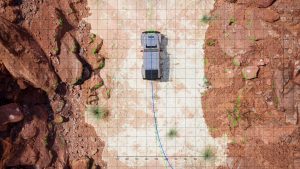
Compound Eye’s growing track record of delivering high-impact sensing technologies, validated through multiple Army SBIR contract awards and successful integration with Army mission needs, positioned the company as a standout candidate for continued collaboration with the Army. In May 2023, the Army SBIR CATALYST Program announced Compound Eye as a selectee. Through the program, Compound Eye intends to leverage VIDAS for positioning and navigation, enabling the vision-based technology to perform simultaneous localization and mapping independent of radar, GPS, or LiDAR, coining the technology VIDAS-SLAM.
The Army SBIR CATALYST Program incentivizes partnerships between small businesses, Army transition partners, and technology integrators to catalyze transition potential through increased funding, with awards that have a potential total of $15 million or more with matching funds. By combining the agility of small businesses with the resources of the Army and integrators, and leveraging a shared-risk, co-investment structure, the program offers a low-risk environment for developing dual-use technologies and closing critical capability gaps.
In September 2024, the company began the Phase II Enhancement phase of the SBIR CATALYST effort having received nearly $2.2 million in combined total funding from Army SBIR, their transition partner PEO GCS, and integrators L3Harris and RTX (Raytheon).
This momentum culminated in a major milestone for the company in July 2025, when Compound Eye officially secured full funding under SBIR CATALYST, receiving and additional $13.3 million to accelerate and transition the development of VIDAS-SLAM with RTX Advantage as their integrator.
Manisha Rafai, the Army’s Technical Point of Contact for Compound Eye and Software Engineering Lead Ground at U.S. Army Combat Capabilities Development Command Ground Vehicle Systems Center, Robotic Software and Controls, underscores the promise of the technology and the pivotal role of the SBIR CATALYST Program in shaping its trajectory. “Compound Eye is making significant strides in developing a robust and cost-effective visual positioning system for the Army. Recent data collection efforts in diverse terrains and ongoing UGV integration demonstrate the technology’s potential to operate reliably in challenging environments, even without GPS,” Rafai said. “This capability is being further refined under the Army SBIR CATALYST Program, ensuring a focused approach to delivering it to our warfighters.”
In addition to the company’s work with the Army, Compound Eye has also secured two Direct to Phase II SBIR contracts with the Air Force. Each contract spans the common theme of passive 3D sensing to enable combat platforms to understand surroundings without emitting a signature. In total, Compound Eye has received over $20 million in DOD contracts.
Compound Eye’s journey, from xTech finalist to multimillion-dollar SBIR CATALYST awardee, demonstrates the critical role of the Army’s innovation ecosystem in accelerating disruptive commercial technologies for national defense. With over $13 million in SBIR CATALYST funding, the company is well-positioned to transition its VIDAS-SLAM solution from concept to operational capability, providing GPS-independent navigation for autonomous platforms in contested environments.
The Army xTech Program is the Army’s premier tool for scouting and accelerating dual-use technologies that directly enhance Soldier readiness and mission success. Through dynamic prize competitions like xTechSearch, xTech identifies breakthrough solutions and opens doors for nontraditional companies to engage with and deliver capabilities to the Army. Since its launch in 2018, xTech has awarded over $30 million in non-dilutive cash prizes across 45 competitions—fueling innovation pipelines and delivering transformative technologies that matter on the battlefield.
Army SBIR actively releases funding opportunities, including Phase I funding for commercially viable, feasible, and technically sound solutions. Firms with mature technologies that meet Phase I requirements can progress to Phase II or begin directly with Direct to Phase II contracts. Army experts in technical, acquisition, and operational fields guide businesses to align their innovations with the Army’s critical needs throughout the process.
Army STTR integrates small businesses into the Army innovation ecosystem by coordinating with universities, federally funded research and development centers, or qualified non-profit research institutions. Small businesses serve as prime contractors, performing at least 40% of the work, while research partners complete at least 30%.
ASA(ALT) leverages innovative technologies to give Soldiers a decisive advantage in any environment by developing, acquiring, fielding, and sustaining the world’s finest equipment and services. For more information, visit the ASA(ALT) web page and follow @ArmyASAALT.